
Read the sermon · 32 min
A wedding and the fear of getting it wrong
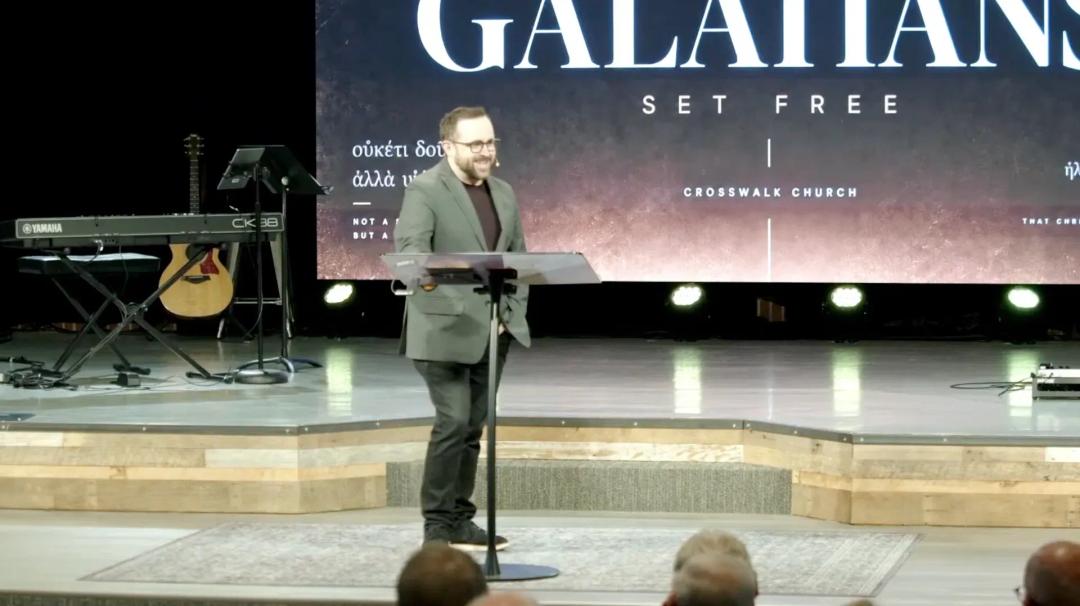
Good morning, everybody. It is so good to be with you all again. My name is Austin Duncan, and I'm the associate pastor here at Crosswalk. This week we are finishing up. The last two weeks we have been in Galatians chapter 3, and this week we are wrapping that up. Last week was the first half, and today's the second half, and it ends with what I think is one of the best sentences in the entire New Testament. So just stay with me until the end.
But I want to start somewhere else. I want to tell y'all a story about a wedding. I've had the privilege of officiating some weddings, and I'll tell you a secret about that job. The officiant has by far the best seat in the house. Everybody else in the room is looking at the back of the couple's heads. The photographer's crouched somewhere in an aisle trying to hide and not be seen, and grandma's second row just looking at flowers. But the officiant gets to stand right there about three feet away, facing the bride, facing the groom.
And as I think about it, the bride has been planning this day longer than she's been engaged. Since she was a child she's been planning this day. She knows where every single person is supposed to stand, she knows which song is playing and when it's supposed to change, and she has a binder, maybe she has two binders. She's got a coordinator with a headset, and man, she's ready. And the groom has been told two things usually, and that is when and where to stand.
From where I stand as an officiant, you can see it. You can see the sweat there at the hairline. He wouldn't sweat like that in the photos, but he's sweating like that now. You can see him lock his knees, which the wedding coordinator told all of them not to do, and there he is locking his knees. You can see him trying to remember to breathe, and you can see his eyes, like he's looking at her but he's also clearly trying to run his lines in the back of his head, like this is a test and I've got to pass. And here's the thing: he doesn't have lines. Not really. That's the beauty of repeat after me in a wedding. It's the easiest test in the world. It's an open book test where the teacher reads you the answers out loud one phrase at a time, and all you have to do is say them back. No one fails the repeat after me.
So a while back I'm officiating a wedding, and we get to the vows, and everything has gone great so far. No one's fainted. This guy didn't lock his knees, which is great. He listened. And the ring bearer's roughly where he's supposed to be. So I turn to the groom and I give him the line, nice and slow. For the sake of the story, we'll just say that the groom's name is John and the bride is Mary. That's not their names, but I didn't ask them if I could share this, so we're changing their names.
I start saying, "Okay, repeat after me. I, John, take you, Mary, to be my lawfully wedded wife." And he looks at her, and he's very sincere, total eye contact, and he says, "I, John, take you, Mary, as my awfully wedded wife." Awfully wedded wife.
I want you to understand, I'm three feet away. I'm the only one who can even respond to this in the moment. So I just said the first thing that came into my head, which was, "Nope." And he laughed, and she laughed, and the room laughed, which is great. We can all breathe. We've got this behind us now. Everybody's loose. So I give it to him again, just slower this time. "I, John, take you, Mary, to be my lawfully wedded wife." So he breathes and he nods at me, like, I got this. He has more confidence than the first time, and he turns back to her, and he looks her right in the eyes, and he says, "I, John, take you, Mary, to be my awfully wedded wife." A second time. He does it again.
So I look at him and I go, "Nope. One more time." He takes a breath, and I'm amazed, because it was word for word the same thing. Somewhere in that man's brain, the nerves maybe combined with the horror of messing it up like that, the official version of the wedding vow in his mind is now "awfully wedded wife." The third time, though, he got it, lawfully wedded wife, and everyone clapped like he'd landed a plane. And I'll share, they're still married, which is great. They have a kid, so all is well.
The anxiety we carry into our walk with God
Part of the reason that story stays with me is that I recognize the feeling on that groom's face. He wanted so badly to get it right, and every attempt made him more aware that he might get it wrong again.
I think some of us bring that exact same kind of tension into our relationship with God. Maybe we mean it when we promise to be more patient, or that we were finally going to deal with that habit, but another week goes by, and now we're wondering whether we've disappointed God too many times to even belong.
Hopefully you get that that story gives us a picture of the anxiety that it's so easy for us to carry in our walk with Christ as believers. And Paul is going to help us hear what God has actually said about our place with him.
For some of us that uncertainty comes from just looking around the room. You look around and you're like, "Man, these people grew up in church. They know the language. They seem to have all the things that I'm still trying to figure out." And so it's so easy for us to wonder whether someone with our background could ever belong as fully as all these other really great Christians in church that we see. And some of us are on the other side of that experience too. We've been comfortable here for so long that we've started treating our own background and our preferences as the standard that everyone else around us needs to meet as well.
That question of belonging is what brings us right here to the book of Galatians, right to Galatia. Paul had preached Jesus. People had believed, and God had given them his Spirit. And like we talked about last week, then other teachers told these Gentile believers that they needed circumcision, they needed the law of Moses, they needed all these other things to actually be full members of God's family, to be God's people. So what is Paul doing? He's writing to reassure them and to confront the teaching that was making them question whether or not Jesus had already given them the things that he'd given them.
Last week we saw that Abraham trusted God's blessing, he trusted his promise, and that faith was counted to him as righteousness. And that Christ bore our curse so that God's blessing could reach us. God promised to bless the nations through Abraham, and through Jesus we are made right with God. We receive his Spirit and we belong to his family as heirs.
That's the promise that we're talking about today. Last week we kept coming back to this: you got in by grace and you grow by grace. I think I said that more times than necessary last week. And then that leads us to this question of, "So why did God give us the law then?" Paul's answer speaks to both sides of the people that are here. It speaks to the person who is wondering whether they belong and to the person who needs to make room for someone who's wondering if they belong. So here's where he's taking us: if you belong to Jesus, the promise belongs to you.
Reading Galatians 3:15-29
To give a human example, brothers: even with a man-made covenant, no one annuls it or adds to it once it has been ratified. Now the promises were made to Abraham and to his offspring. It does not say, 'And to offsprings,' referring to many, but referring to one, 'And to your offspring,' who is Christ. This is what I mean: the law, which came 430 years afterward, does not annul a covenant previously ratified by God, so as to make the promise void. For if the inheritance comes by the law, it no longer comes by promise; but God gave it to Abraham by a promise. Why then the law? It was added because of transgressions, until the offspring should come to whom the promise had been made, and it was put in place through angels by an intermediary. Now an intermediary implies more than one, but God is one. Is the law then contrary to the promises of God? Certainly not! For if a law had been given that could give life, then righteousness would indeed be by the law. But the Scripture imprisoned everything under sin, so that the promise by faith in Jesus Christ might be given to those who believe. Now before faith came, we were held captive under the law, imprisoned until the coming faith would be revealed. So then, the law was our guardian until Christ came, in order that we might be justified by faith. But now that faith has come, we are no longer under a guardian, for in Christ Jesus you are all sons of God, through faith. For as many of you as were baptized into Christ have put on Christ. There is neither Jew nor Greek, there is neither slave nor free, there is no male and female, for you are all one in Christ Jesus. And if you are Christ's, then you are Abraham's offspring, heirs according to promise.
We can follow Paul's argument by holding on to three things: God's promise still stands, his law shows us our need, and belonging to Jesus gives us a place in God's family. Let's work through those together.
God's promise still stands
Paul begins in verse 15. He says, "To give a human example, brothers, even with a man-made covenant, no one annuls it or adds to it once it has been ratified." That means once a binding covenant, once a binding commitment has been established, nobody can just casually come in and rewrite the terms and undo the thing that was promised.
Imagine somebody, we'll go with the wedding analogy still, stands up at a wedding reception and says, "Okay, y'all, hang on. Before we get too far into the cake, I have a few extra conditions for this marriage." You would be like, who invited this person? The vows have already been made. We already made our vows. What are you doing adding extra stuff here? God doesn't add fine print after the vows. Paul wants the Galatians to take God's promise at least as seriously as they would take a human agreement.
For a picture of how seriously God commits himself to his promises, let's go back to Genesis chapter 15. Last week we heard that Abraham believed God and it was counted righteous. But a little later in that same chapter, Abraham asks God, "O Lord God, how am I to know that I shall possess it?"
God tells Abraham to bring animals and arrange the larger ones into divided pieces, leaving a path between them. This very solemn covenant ceremony expresses the seriousness of the commitment and the judgment that was associated with breaking it. And then Genesis tells us, "As the sun was going down, a deep sleep fell on Abram." And verse 17 describes what follows: "When the sun had gone down and it was dark, behold, a smoking fire pot and a flaming torch passed between these pieces."
Those signs of God's presence pass through while Abraham sleeps. They confirm God's commitment to fulfill his promise. That's what that's teaching us. Think back to the groom at the very beginning who's trying so hard to repeat his vows. Here, Abraham's ability to say everything correctly never even becomes the basis of the promise to begin with, because God himself confirms it.
Abraham is going to spend the rest of his life learning how to trust and how to follow him. And that life will include some very beautiful moments and some very painful failures. But through all of it, the future that God has promised rests on God's faithfulness. God stakes his own name on what he has promised. And Abraham, and we too, can rest in the character of the one who made that commitment.
That's why Paul brings up the timing in verse 17: "The law, which came 430 years afterward, does not annul a covenant previously ratified by God, so as to make the promise void." He's saying, whatever purpose the law would serve, its arrival never canceled what God already promised Abraham.
I think sometimes we act as though God keeps updating the terms of our relationship. We know that he's welcomed us through Jesus. We know that. But then we imagine a performance requirement that we have to meet in order to keep our place. And when that's the case, then a bad week can easily start to feel like our standing is just up for review. Your worst week cannot rewrite God's promise.
So what do you do with that? Bring that week to God. Confess what needs to be confessed and trust the Savior who brought you near to him.
Then verse 16 shows us where this promise even leads. Paul identifies Abraham's promised offspring as Christ. Offspring can describe a whole family, and Paul uses it that way later, we'll see that, but here he directs us to the one through whom the promise is fulfilled. Through Jesus the blessing reaches the nations. Jesus is where God's promise meets your life.
These teachers there in Galatia are demanding more qualifications. And Paul is showing the Galatians what they already have in belonging to him. In fact, verse 18 puts it very plainly: "For if the inheritance comes by the law, it no longer comes by promise, but God gave it to Abraham by a promise." That word gave tells us how we receive the inheritance. Treating it as something that we can earn changes the entire basis of receiving it. Grace stops being grace the moment you try to pay for it.
So when your mind starts reviewing why you might be disqualified, let me encourage you, bring your attention back to the one who made the promise. His faithfulness, that's where your confidence belongs.
Why then the law?
But that still leaves us wondering, why did God give the law? Paul asks himself this in verse 19: "Why then the law?" He's talking about the law that God gave Israel through Moses at Mount Sinai, with its commands, its sacrifices, and instructions for life as his people. That covenant came after the promise to Abraham, and it served a very particular role in the story leading to Christ.
Paul answers it for us. He says, "It was added because of transgressions, until the offspring should come to whom the promise had been made." Sin already existed. But the law made Israel's disobedience explicit by spelling out what it was that God required.
Having God's commands never meant having a clean record. The people who possessed them needed mercy also, as they waited for the promised Christ, just as much as we need it. But we recognize ourselves as we read through these commands today. We call harshness honesty. We call greed ambition. Maybe we call resentment merely having a good memory. Until what? Until God's commands about love and truth confront our explanations. So that also means that the law brings our excuses to an end. Or it should. That means that we can recognize its truth without placing ourselves under the covenant that Paul says served until Christ came.
I learned something about exposure in a dark room at Texas Tech University. Before I was in ministry, my undergrad degree was in art, studio art. I heard chuckles. That's not funny. It was specifically a concentration in photography, and then they called it digital printmaking. The point is, before I ever shot digital, before they ever let us touch a digital camera, we had to shoot on film. We still had a working darkroom and all that. So I shot on film and I had to develop the roll and then head into the darkroom and use an enlarger with the negatives.
You go through that entire process: taking the film out, loading it into the canister, all the chemicals in there, it develops, and you take it into the enlarger with the negative that you're going to expose, and then that gets exposed on the paper and you take it through all the fixer and developer. And then you get to take it out into the room and, oh, it's out of focus. So you go again and you make your adjustments. I'll use a different negative. Maybe that one's not out of focus. And you go through all that again, and then you come back and you're like, "Ah, it's overexposed."
But by the time I'm even looking at these photos, the moment in which I captured them on the camera is weeks ago. That's long gone. The point is that the darkroom doesn't create the mistake. It reveals it. The mistake had already been made when I took the picture.
In that same way, the law exposed the sin already there in Israel's life. And those commands help us recognize our own need for mercy. What God says about anger changes how we see the way that we speak to someone. It should. And what he says about love makes our indifference way harder to justify. That can be uncomfortable, but there is mercy in being told the truth. God tells you the truth so you can stop hiding. We can finally bring him what we have spent so much energy in our lives defending. We just bring it to God.
At the end of verse 19, Paul says that the law came through angels and an intermediary, referring to Moses. Verse 20 adds, "Now an intermediary implies more than one, but God is one." As Christians, we understand the details of that difficult sentence. Some Christians understand it differently than others, but within all this, it reinforces the distinction between the mediated giving of the law and God's own commitment in that promise. The law cannot replace that promise.
The law exposes but cannot fix
Paul asks in verse 21, "Is the law then contrary to the promises of God?" His answer is, "Certainly not." And he explains, "For if a law had been given that could give life, then righteousness would indeed be by the law." What does that tell us? It tells us that the law can expose our guilt, it can expose all of our sins, but it cannot give sinners a right standing before God and the life that comes with it.
There's a hobby that I started somewhat recently that I'll share with you. I think build is maybe a generous word, but I've gotten into this hobby of assembling watches. I order all the parts online and they come in and then I assemble the watch into something you can wear. Not this one, but into one that you can wear, and it's a real watch and it tells time, kind of. It's a hobby that makes you feel very patient, until that tiny screw rolls off the desk. I have been in my office here with a magnifying glass, so to speak, just looking for a tiny screw. I've been at my house looking for a tiny screw. And you can't use a magnet, because then it's magnetized.
Whenever you get finished assembling the watch, then you put it on a time graph. You can buy them. They're expensive. I don't have one, so I use an app on my phone, and who knows how well that works. But the point is that the phone listens and it can tell you how many seconds that watch is gaining or losing over the course of a day. You could check it twice a day. And I could tell you that I am the world's best watch assembler at making a watch that doesn't really keep time all that well.
That time graph tells me the same thing. I see it and I'm like, "Golly, 15 seconds." But eventually somebody's going to have to make that watch repair. The point is that you can measure that problem. I could measure that problem all day long, but it's not going to solve itself. You still need somebody to fix it.
Some of us become such experts on our own failures, hoping just enough improvement will finally make us right with God. But a command that exposes guilt cannot remove it. Last week Paul told us what Jesus did about that guilt, that he bore the curse that our sin deserved. That means that our hope rests on the Savior who gave himself for us. And we receive what he gives through faith.
That's where Paul goes in verse 22: "But the Scripture imprisoned everything under sin, so that the promise by faith in Jesus Christ might be given to those who believe." Scripture closes off any attempts we might make to try and prove that, well, Jesus knows all these other people, but I'm the exception. No.
We can stop comparing ourselves with people whose failures are more visible than ours, maybe. We can stop comparing ourselves with people who we think might have it all figured out, and we can just admit that we all need the same Savior. Listen to the purpose of this: "so that the promise by faith in Jesus Christ might be given to those who believe." Facing our sin opens our eyes to our need for Jesus. When we finally say, "Okay, I on my own cannot make myself right with God," that should lead us to a place where we can ask for the mercy that we cannot provide ourselves. The end of your excuses should become the beginning of an honest prayer to God.
The guardian's season has ended
Paul gives us one more picture of the law's role in verses 23 through 25. "Now before faith came, we were held captive under the law, imprisoned until the coming faith would be revealed. So then, the law was our guardian until Christ came, in order that we might be justified by faith. But now that faith has come, we are no longer under a guardian."
Listen to the weight of that kind of language that Paul's using there. Held captive. Imprisoned. Life under the law involved real restraint and exposed guilt. Paul is describing a period under the Mosaic law before Christ's arrival. But also notice, Abraham had already trusted God centuries earlier, so faith itself was certainly present. But now the Savior to whom the promise pointed has come. And we get the wonderful privilege of living on this side of that promise, on this side of the cross.
The guardian supervised the child and exercised discipline until the appointed stage of life had passed. In my mind I go to a modern babysitter, which gives us a very limited picture of this kind of supervision, although Paul's image carries much stronger restraint and much stronger authority.
So imagine you're mid-twenties and paying for your own car insurance, as you should be, and you come to find your childhood babysitter sitting on your couch when you get home. You walk in and she's asking all about your homework and telling you that your screen time's all up. You'd be like, "I don't even need your permission to drive anymore, and here you are." Eventually you have to say, "I think we need to talk about the arrangement here."
The law's season as guardian has ended with Christ's coming. Those Gentile believers receive their full place in God's family through faith in Jesus, and taking on the Mosaic covenant, you can't improve on that place. Christ has brought his people into freedom.
And God cares deeply about how his children live. Paul writes in Galatians 5:14, "For the whole law is fulfilled in one word: you shall love your neighbor as yourself." He goes on to tell believers to walk by the Spirit. So the same letter that announces our freedom from the law's guardianship calls us to love our neighbors and depend on God's Spirit as we obey.
The Father who welcomes you into his family also walks with you. If that's not the most comforting thing you can hear, I don't know what is. He gives you help as you learn patience with your child. He gives you the courage to tell the truth, and humility to ask for forgiveness when you need to ask for forgiveness. So your obedience grows within the relationship that Paul is now describing to us.
All means all
Verse 26 says, "For in Christ Jesus you are all sons of God, through faith." Imagine hearing that after being told by all these teachers, here's all these things that you still have to do to even be able to qualify.
That word all reaches every believer. All means all. That includes the person with the least amount of knowledge. That includes the person who has a really complicated history. Or this quiet feeling that everybody else here belongs more than you do. You're included in that too.
Paul's language of being children of God, of being sons, carries this sense of family standing and the sense of inheritance. And then the next few sentences make it clear that women and men also share in this blessing. What does that tell us? That every single believer has a place in the family and a share in what God has promised.
Our gifts and our maturity during that walk are going to differ. Not everybody's at the same place at the exact same time. And some of us need a great deal of help learning how to live as God's children, myself included. But we all come to faith in the same Savior. Nobody gets a better Jesus than you. The believer that you admire most depends on the same grace that also welcomes you.
So you can come to God with confidence in the one that you share, in the grace that you share. And let that shape the way that you pray also. If you belong to Christ, you can come to him as someone whose Father has welcomed them. You can ask for wisdom without pretending that you already understand everything that there is to understand. In fact, Josh has a great phrase that I've heard him say before for pastors, kind of like the nail in the coffin for a pastoral ministry, and it's the phrase, "I've got it all figured out."
You can come to Christ with humility. You can confess your sin without giving a ten-minute explanation of why it wasn't entirely your fault to begin with. This relationship has room for the truth about you. A child still needs correction and has plenty of growing to do. And a loving Father cares enough to be involved in all of that. You can bring in the parts of your life that need his help.
We wear the same Christ
Verse 27 says, "For as many of you as were baptized into Christ have put on Christ." Baptism identifies us with Jesus and his people, and Paul describes that belonging through clothing. Our standing before God rests on Christ, and that shared identity changes, hopefully it should change, how we see the people around us. The person that maybe when you walk out of here, you see them across the lobby and you're like, "Ooh, I'm going out this door." Hopefully not. No one here has ever done that.
We know how quickly clothing can tell us things like where someone works. It can tell us which team they support. Yesterday my family and I were at the craft fair, I guess you could call it, in Bell Buckle with the rest of Middle Tennessee. And I'm a big Pittsburgh fan, I'm trying to say this carefully, with all sports. Going to the different jersey shops, I went into one and asked the guy if they had any Pittsburgh stuff, and he was like, "Oh, I don't know. If I do, it's back in the corner, but we have Tennessee stuff up here." And then he proceeded to go grab a Tennessee jersey and bring it to me and say, "This is the one that you should buy, not that." He's like, "I'm trying to convert him." But the point is, even clothes tell you so much. They tell you which team you support, or what kind of occasion someone is coming from or going to. We notice those signals, and sometimes we start sorting people before we've ever even spoken to them. I just mentioned clothes with Pittsburgh and I could feel it.
Paul gives these believers a shared identity that reaches deeper than these superficial distinctions that we come up with to rank one another. We wear the same Christ. And we belong to the same family. So that should give us freedom to be honest about our stories and a reason to welcome people whose stories are different from our own.
That's why verse 28 follows so naturally: "There is neither Jew nor Greek, there is neither slave nor free, there is no male and female, for you are all one in Christ Jesus." Gentile believers were being treated as though their background left their place incomplete. And Paul's like, "No, no, no, no. You belong equally with the Jewish believers." And then he carries that truth across all these other divisions in their world: ethnicity, social position, or sex, which gives someone no superior claim to more grace than anybody else. There are no second-class children in God's family. The believer whose life looks very, very different from yours has been welcomed by the same Savior as you. Whatever growing either of you needs to do, you both share the same foundation for belonging.
Make room at your table
That brings us back to something we talked about right at the beginning. Some of us have spent years wondering whether our background keeps us as a pariah or an outcast in the family. And we're also looking at people who it seems like they've grown so comfortable that we barely notice.
Imagine two believers joining a conversation. Maybe one grew up in church and knows all the familiar jargon and language and all of those things, and the other came to faith as an adult and has to ask, "What are some of those words you're saying? What does that mean?" Do you make room for that question? Or do you exchange a look with someone else, or even with that person, as if they should know.
Christian maturity matters a lot. I'm not discounting that. The point is that we should help each other grow. I'll put it this way: don't let your familiarity with church culture become an extra qualification that you expect someone else to learn.
Earlier in Galatians chapter 2, Josh talked about this. Peter had been eating with Gentile believers and then pulled away because he feared the circumcision group. And Paul confronted him, because that behavior contradicted the gospel. So think about the people that you invite to your table. Would a believer whose income or education or family history is different have the same welcome? And these are questions for all of us. I'm asking you, but I'm included in this.
We can affirm equality in Christ while sometimes reserving our closest attention for people who feel familiar to us. I'll put it this way: if Jesus calls them family, make room for them. Invite that person into your home. Listen without making them apologize for who they are, and take their faith seriously even when their story might be different than yours. Let your welcome reflect that you believe in Jesus as much as they do.
Peter talks about it, when people visit the church, they should be able to experience the gospel before they ever even hear a word being taught to them. It's how we should be living our lives.
Heirs according to the promise
Listen to verse 29: "And if you are Christ's, then you are Abraham's offspring, heirs according to promise." Heirs according to the promise. What does that tell us? Heirs don't earn the inheritance. They belong to the family.
The promise reaches its fulfillment in Christ, and everyone who belongs to him shares in the inheritance. These Gentile believers receive Abraham's blessing through faith in Jesus, and you can read those words and accept them in your own life and in your mind too. And remember what that includes. Galatians 3:14 says Christ redeemed us, why? "So that we might receive the promised Spirit through faith." God makes us right with himself and gives us his Spirit. In chapter 4, Josh is going to get to this and I don't want to step on his toes, but in chapter 4 Paul explains that God sends the Spirit of his Son into our hearts, enabling us to call him Father.
Our belonging rests on what God has done, even when our feelings can so easily struggle to catch up to that. So if you belong to Jesus, the promise belongs to you. You have a Father who's welcomed you, his Spirit within you, and a place among his people as an heir.
Your background cannot make Jesus an insufficient Savior. Your background also cannot give you a greater claim than someone sitting next to you. Both of you receive the same grace. An heir has a future. Why? What did they do to earn that? They have a family that they belong to.
We cannot predict what next year will ask of us. I don't even know what's going to be asked of me this afternoon. My wife probably does, I don't. But regardless, we still know whose children we are and whose Spirit is with us. You can carry that promise into every single uncertain day that you face. And you can trust God with the future that he's promised. So live from the place that he has given you.
Belonging gives you a place to grow from
When I think about that wedding, I can still see the groom trying so hard to get those words right. Some of us have carried that tension into our life with God for years, waiting to feel just qualified enough to even belong here, to feel like you have to do something to be able to walk in these doors.
Hear what Paul has told you: that through faith in Christ, God has welcomed you as his child and given you his Spirit. You can bring your Father the sin that you need to confess, the fear you've been carrying, and the help that you need to take your next step. So hear me when I say, belonging gives you a place to grow from.
If you've been making someone feel like they have to earn the place that Jesus gives, and I think we're all guilty of that at times, bring that to him. Think of the person whose background you've judged or whose questions you've dismissed. An apology or an invitation or just a patient conversation can make the truth that God is telling us right here in chapter 3 so visible this week.
And if you've never trusted Jesus, you can turn to him today, right now. He gave himself for sinners, and he rose from the dead. He knows the truth about your life already. And you can ask him to forgive you and begin following him in faith as your Lord and Savior right now.
I want to read these last four verses again as I wrap up, and listen to what God says about everyone who belongs to his Son.
For in Christ Jesus you are all sons of God, through faith. For as many of you as were baptized into Christ have put on Christ. There is neither Jew nor Greek, there is neither slave nor free, there is no male and female, for you are all one in Christ Jesus. And if you are Christ's, then you are Abraham's offspring, heirs according to promise.
Take those words home with you, in your heart, in your mind. Come honestly to the Father, depend on his Spirit, and make room at your table for those that he calls family. If you belong to Jesus, the promise belongs to you. God kept his word in Christ, and you can trust him with your whole life.
Let's pray. Father, thank you for keeping your promises and giving us the Savior that we need. Thank you that through faith in Jesus we are your children. Thank you that your Spirit lives in us, and that our future rests in your faithfulness. Lord, I just ask that you help any of us who are exhausted from trying to earn our place, just to receive the grace that you've already given us. Lord, I ask that you forgive us for the ways that we've made others feel like they have to earn their position. Lord, I ask that you give us humility to recognize our own need for mercy, and love that makes room for every single person who belongs to you. And Father, I ask that you teach us to depend on your Spirit as we obey, that we trust you enough to tell the truth, that we trust you enough to ask for help and to actually receive it, and to have the courage to take our next step. In Jesus' name we pray. Amen.