
Read the sermon · 32 min
A lunch I paid for twice
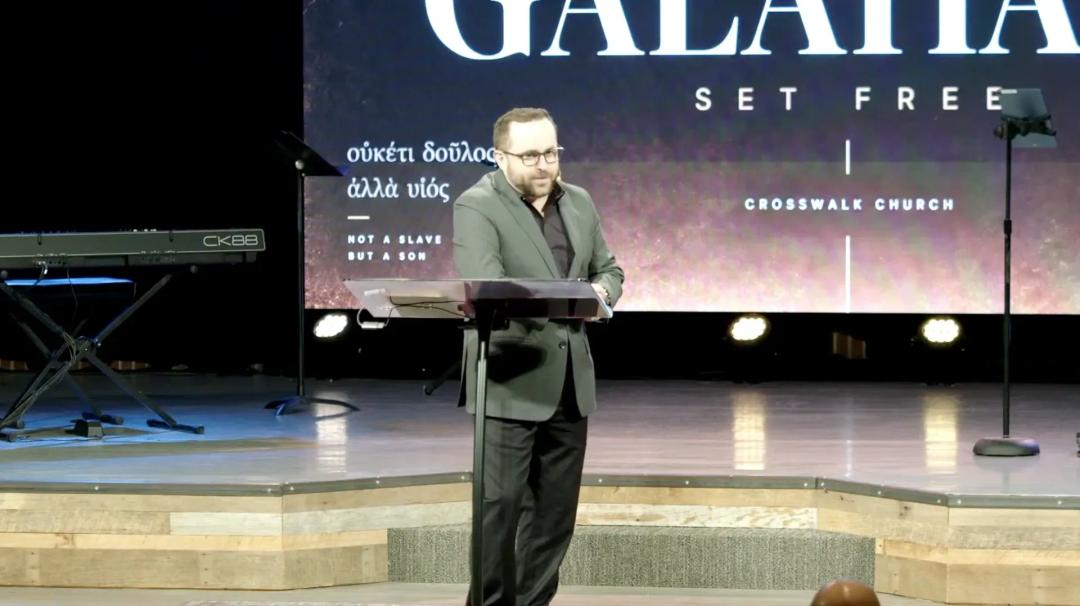
Good morning everybody. It is so good to be with y'all this morning. My name is Austin Duncan, and over the next couple of weeks we're continuing our series in Galatians. We're going to be in Galatians chapter 3, which is, I think, one of the most important chapters in the New Testament and maybe also one of the most stressful, because Paul opens it by like yelling at people. So we're going to get to that, but I want to start with something that happened to me semi recently. And I'm telling you because this is kind of the whole sermon, and I'd rather you just have it at the beginning.
I went to lunch recently with a guy here at the church. I'm not going to mention his name, but it was the first time the two of us had ever gotten lunch, just the two of us. And so I'm doing the thing where whenever you're in that situation, maybe you're a little bit more put together than normal. I'm thinking, okay, I'm going to ask good follow up questions, I'm going to laugh at jokes and things like that. And I'd made a decision on the drive over that in my mind I'm like, okay, I'm buying. The entire way there, that's the plan, right? He's taking time out of his day just to hang out and have lunch with me, so I'm getting this one. And I'd even thought about how to do it smoothly, like the hand on the check, no, I've got this, like the gracious little wave off whenever he objects. So the point is, I was going to be the giver. I'd rehearsed being the giver.
And so we had a good lunch, good conversation, and the server comes by and sets down the checks, separate checks. That's fine. I'm like, this is even better, I'll just grab both, that's smoother. And so she sets them down and I go to grab my wallet. No. If you've ever done this, you know what happens, right? Your body knows what to do before your brain catches up. It's the pat, right? Front pocket, back pocket, front pocket in case it moved. I'm just missing which pocket it's going to. I pat my jacket. I'm not wearing a jacket. I'm patting air.
And the server's still standing there, and servers, they've seen this before, right? There's a face they make. It's not mean, but it's the face of someone who's like, I know how this is going to go, we'll just wait for him to catch up. And at some point you stop looking for the wallet and you start looking for an exit. So I look up at this man that I've spent the last hour talking to and getting to know and I say, hey, do you know if they take Apple Pay? That's not really a question. It's more of a confession.
And he could not have been nicer about it, by the way. Didn't even pause. Just said, oh hey, don't worry about it, I got it, I'll get it. And that's the nicest thing that a person can say to you in that situation. But in my mind, it's maybe not the thing that you want to hear right away, because I'm not thinking, oh, how generous. I'm thinking, how do I recover from this? The first lunch, and I've turned it into a charity.
So I spent the drive back to the church drafting out my text that I'm going to send. I'm like, lunch, exclamation point, thanks again. Yeah, that's good, that's easy. And then I'm wondering if the exclamation point's too much. And then I'm wondering, what if it's not enough? I could send two. No, that's weird, that's even worse than the one. And then I'm wondering if I should round up. And I'm like, that's more weird, like I'm tipping him. I've never thought this much about anything.
So I Apple Cashed him from the parking lot, settled up square, let his gift last 22 minutes, and then it's over. All better, right? So I get out of the car here at the church, and I turn around and I close my door and look down in the floorboard. Wallet. I guess it had slid out of my pocket getting out or getting in or something. So the entire time I'm there checking my pockets, the thing that I needed was sitting like 20 feet from the restaurant door.
So let's review. I drove to that restaurant planning to buy lunch, and he bought lunch, and I paid for it anyway. I'd had the money the whole time. But I bought that lunch twice. Once with Apple Cash and once with dignity.
Turning a kindness into a debt
Here's what I've thought about this since. I walked in there in my mind as the guy who pays. That was my posture. And in about an hour I became the guy who gets paid for, and I couldn't handle it. He said, oh, I'll get it, and he meant it. It was a gift. And for whatever reason, I don't know what it is in me, but I just couldn't let it be one. Something in me took a kindness and converted it into debt instantly, before the server had even grabbed the checks with the card on it. That was fast. I wanted to pay him back so that I could go back to being the guy who pays.
And I think a lot of us know what this feels like, because that same feeling follows us into our relationship with God. If I asked you how a person becomes a Christian, you could probably tell me, oh, by grace through faith in Christ alone. We know that answer as believers and we believe it. But then the week happens. Thursday afternoon comes around and you've lost your temper, or maybe you've barely prayed all week and you can't even remember the last time that you opened your Bible. There's dust on it, you can blow it off. In that moment, how easy is it to go to God? How often do you catch yourself thinking, I probably need to get some solid days in first?
And then you have a really good week. Maybe you've been patient with your family, you've made time to serve, you've been up here doing stuff at the church, you've actually kept up with your Bible reading. Maybe you even let somebody merge in traffic and you were actually okay letting them merge in traffic. Suddenly prayer feels a little bit easier, right? You go to God and you're like, yeah, I'm on top of things, I got this.
But what changed between those two different weeks? Not Jesus. Not what he accomplished at the cross. That's still the same. But somewhere along the way we start treating our performance like it's permission to be able to draw near to God. It's almost like we know how to talk about grace, but we're still learning how to stop reaching for the check.
And that's where our passage today meets us, and that obedience matters, and as Christians we should be growing. And so Paul is going to help us understand how that happens. As we listen to him, I want you to keep one question in mind throughout this morning: what are you depending on in your relationship with God? When you think about whether he welcomes you, where does your mind go first? Does it go to what Jesus has done for you, or does it start reviewing what you've done for him?
Jesus and one more thing
Here's what's happening in Galatians. Paul brought the good news about Jesus to the churches, and people heard it, they believed it, and they received the Holy Spirit. And many of them who heard that and received it were Gentiles who hadn't grown up under the law of Moses. So they were coming to know the God of Israel through Jesus.
And then other teachers showed up with a message that sounded something like this: well, Jesus, he's a wonderful beginning, but if you really want to belong to God's people, there's things you've got to do. There's extra steps. You need circumcision. You need to take on the law of Moses. Basically the statement is that faith in Jesus gets you started, so now let's talk about what really makes you part of the family.
You can see how that might sound reasonable to somebody who's just beginning to follow Christ. They want to grow. They want to take their faith seriously. And here's people offering to show them the next step. And the message they share amounts to basically Jesus and one more thing. And that one more thing changes the entire thing. If something else has to make you acceptable to God, then Jesus hasn't done enough to make you acceptable to God. Our belonging to God is at stake in that kind of teaching, and that's why Paul says it with such urgency.
Reading Galatians 3:1-14
So I want you to listen to how he addresses them in Galatians chapter 3, starting in verse one. He says this:
O foolish Galatians! Who has bewitched you? It was before your eyes that Jesus Christ was publicly portrayed as crucified. Let me ask you only this: Did you receive the Spirit by works of the law or by hearing with faith? Are you so foolish? Having begun by the Spirit, are you now being perfected by the flesh? Did you suffer so many things in vain, if indeed it was in vain? Does he who supplies the Spirit to you and works miracles among you do so by works of the law, or by hearing with faith, just as Abraham believed God, and it was counted to him as righteousness? Know then that it is those of faith who are the sons of Abraham. And the Scripture, foreseeing that God would justify the Gentiles by faith, preached the gospel beforehand to Abraham, saying, In you shall all the nations be blessed. So then, those who are of faith are blessed along with Abraham, the man of faith.
For all who rely on works of the law are under a curse; for it is written, Cursed be everyone who does not abide by all things written in the Book of the Law, and do them. Now it is evident that no one is justified before God by the law, for The righteous shall live by faith. But the law is not of faith, rather The one who does them shall live by them. Christ redeemed us from the curse of the law by becoming a curse for us, for it is written, Cursed is everyone who is hanged on a tree, so that in Christ Jesus the blessing of Abraham might come to the Gentiles, so that we might receive the promised Spirit through faith.
There is a lot in that passage, with the Spirit, with Abraham, the law, blessing, and a curse all coming together. And so if you heard that, you might be thinking something along the lines of, cool, I understood the lunch story, let's go back to that. Just stay with me, because Paul gives us a question that ties the whole thing together, that holds this whole thing together. In verse two he asks, "Did you receive the Spirit by works of the law or by hearing with faith?"
What's that question do? He's asking them to remember how they even got in. Did they earn their place with God, or did they receive what God gave them? And Paul takes us to three places to answer that question. He takes us to their beginning, to Abraham's story, and to the cross of Jesus. So we're going to move through those three places together. And as we move through them, here's what I want you to keep in mind: as a believer, you got in by grace. And as a believer, you grow by grace. Our dependence on Jesus continues through every part of the Christian life. And Paul wants us to see the freedom that comes from living that way.
Losing sight of the finished work
So how does Paul open this chapter? He opens with, "O foolish Galatians! Who has bewitched you?" I read that and I'm like, that's an interesting way to start a pastoral conversation. If you came in my office to talk to me and I was like, oh, you fool, who's bewitched you? You're like, what did I walk in here? Who is this guy?
But I want you to hear what's underneath his words. Paul loves these people. He brought them the gospel, remember, and now he's watching them turn away from the very thing that gave them life. And so you can almost hear him asking, what happened? You saw this so clearly when I was with you. So how did you lose sight of this? What's going on?
And he reminds them it was before your eyes that Jesus Christ was publicly portrayed as crucified. Paul had preached the cross so clearly that it was as if they could see Jesus hanging there. They had heard about what he had done to save them and they put their trust in him. And now their attention was being pulled toward everything that they still needed to do. Basically their own unfinished work. That's what was filling their sight, taking up the entire field of view that they had. And when that's the case, they started losing sight of Christ's finished work.
And that's a shift you can make mentally without ever leaving church. You can keep singing the same songs and reading the same Bible while slowly starting to look to your own record for the peace that only Jesus can give you. You hear about God's love, but maybe you spend the drive home reviewing whether you've even done enough to deserve it. Or you sing about forgiveness, but maybe you carry your failures around as though the final decision about you is still waiting on you to have a little bit better of a week.
You already have the keys
So Paul brings these believers back to the beginning and he asks, did you receive the Spirit by works of the law or by hearing with faith? They knew God had been working among them. Why? Because their lives had changed. So the question was, how did it happen? Had they received the Spirit after they kept the law and proved how serious they really were? They could look back at their own story and remember hearing the good news about Jesus, about trusting him, about receiving God's Spirit. God had welcomed them before these teachers ever showed up with their list of requirements.
Just think about this with me. Imagine that somebody hands you the keys to a new house. You move in, you unpack your things, get your Keurig or whatever it is set up, and you're in the kitchen making coffee, and you get a knock on the door. You go to open it and this person's like, hey, good news, I can tell you all about how you can qualify to live here. If that were me, I'd look down at my coffee cup and I'd be like, but I already live here. I have the keys. The owner gave me the keys.
That's what Paul wants them to recognize. God had already welcomed them. So why were they letting somebody convince them that they still needed to qualify to be able to be let in?
Begun by the Spirit, perfected by the flesh?
And that leads us to the question in verse three, which says, "Having begun by the Spirit, are you now being perfected by the flesh?" Had God brought them to life so they could take it over from there? That's the question. Was their own strength supposed to finish what the Spirit had started?
Maybe you're different than me, but I would feel awfully uncomfortable saying, oh, thank you, Holy Spirit. Yeah, I've got the rest, I can handle it. Thanks for starting stuff. But we can drift into living that way so gradually that we barely notice that it's happening, don't we?
Think about something as simple as just reading your Bible. Why do you start? You should start because you want to know the God who loves you, and there's a real hunger there to know him better. Maybe you're discovering things that you never saw before, and you should be grateful that the God who speaks through his word is speaking to you through the Bible. Over time, though, that habit can start to become like a scorecard that we start keeping. Maybe you miss a morning and the disappointment, it just turns into fear, because you're afraid that you've lost ground with God. Maybe you have the Bible app and you open it and you see that your streak is gone. Man, that little flame isn't there anymore. Suddenly I wonder if that starts to matter more than the cross does.
Keep the Bible out, by the way. Keep reading your Bible. It's a good habit. Good habits are a gift. But as you open it, pay attention to what you're hoping that habit is going to do for you. Is the point of that habit to draw near to the Father who already welcomes you in Christ? Are you trying to convince him to welcome you? You can read the same chapter with either of those expectations and they can lead to very different experiences of the Christian life.
The same thing happens when we serve. Two people can stack the same chairs while carrying completely different thoughts in their minds. One might be thinking, man, God has been so kind to me and I'm glad that I even get to be here to help. And the other might be thinking, well, hopefully somebody sees me doing this. Maybe this will make up for the kind of week that I've been having. Doing the exact same thing, but one of them's carrying the extra weight of trying to repair their standing with God.
Belonging first, then obedience
Paul wants to lift that weight off of our shoulders so we can understand the order of things correctly. That order is that belonging comes first and obedience comes from there. Later in the letter Paul talks about faith working through love and about the fruit of the Spirit. He describes that love, joy, peace, patience, and kindness, all of which show up in actual decisions and actual conversations that we have. And my point is that when the Spirit works in us, the people around us should be able to experience the difference. When we learn to tell the truth, or forgive a difficult person, or give generously because we're depending on him, obedience has a real and necessary place in our lives. But it cannot carry the weight of making us right with God. God's already given us that gift through Christ.
In fact, think about how much that changes repentance. If you believe that you have to earn your way back, you'll be tempted to hide until you can give a better report to God. Maybe you'll make excuses and promise yourself that next Sunday you're actually going to show up here with something to show to God.
Or, when your welcome as a child of God rests on Jesus, you can tell the truth today. You can do that right now. You can say, Father, I sinned and I need your forgiveness. I need your help to see what obedience looks like in this moment. You can come with the truth while failure is still something that might be fresh in your life. And that kind of honesty with God leads you well. You confess, you apologize to the person you hurt, and take the next step with God's help. It's grace that gives you the freedom to face what happened and to be able to begin to put things right.
So when you feel the urge to pull away from God, maybe because you're ashamed, remember this. When you fall, run to the Father, tell him the truth, and you can depend on him for the strength to respond.
He supplies, present tense
In verse four, Paul asks whether everything that they've suffered has been in vain. That means that following Jesus has cost them something, and he doesn't want them to abandon the gospel. And then verse five brings us back to the question. He says, "Does he who supplies the Spirit to you and works miracles among you do so by works of the law, or by hearing with faith?"
I want you to notice this. Grammar, sorry. Notice the tense of that word supplies. It's not supplied. It's supplies, because God is still at work. Your story is still unfolding. And they depend on him at this point when he's writing this just as they did when they first believed.
As we grow, our habits and choices should change. We should see that happening. And there will be things that we understand more clearly than we did at the beginning. But we never reach a level of maturity where we can tell God, oh, I'll take the reins, I've got it from here. Growing in Christ means growing in our dependence on him. You start recognizing how much you need him in your marriage, your parenting, and your patience with the person who always makes things harder. Maybe you learn to pray sooner, confess sooner, and ask for help before you've just exhausted yourself pretending you can handle it all alone. That's what growth can look like just in an ordinary week. The circumstances can be the same week in and week out, but you're learning to bring them to God and depend on his Spirit as you respond to those. You got in by grace and you grow by grace.
Abraham believed God
Now, somebody listening to Paul might say, that sounds great, but you mentioned Abraham. What about Abraham? What about the way that God has always dealt with his people? I love that, because Paul's like, oh, I'm so glad you asked, I've been preparing, I'm already ready for it. Because Abraham's story takes us right to the heart of what he is saying. Read with me in verse six. Paul writes, "Abraham believed God, and it was counted to him as righteousness."
Abraham matters so much here because God had made his covenant with him. And circumcision was the sign of that covenant. And these teachers were using that history to tell Gentile believers what they needed to do to become part of Abraham's family. So Paul takes them back into the story and he asks them to look really carefully at how Abraham himself was counted righteous before God.
He points them to Genesis chapter 15, where Abraham is living with a promise that he still hasn't seen fulfilled. If you remember that promise, God promised him descendants, but he and Sarah still don't have a child together. And they're growing older, the years are passing, and Abraham can't see how this is even going to be able to happen. And you know that feeling of looking at your circumstances. Maybe it's easy to look at them and you're struggling and you're thinking, I just can't understand how God is going to work through this.
That's where Abraham is. God brings him outside and tells him to look up at the stars. What does God say? I love the second part of this phrase. He says, number the stars if you're able to number them. He then tells Abraham, so shall your offspring be. Imagine that as you have spent years hoping for one son. And God is speaking about more descendants than you can even count. And the promise reaches so far beyond anything that Abraham could just make happen in and of himself. Abraham's future depends on the God standing behind that promise.
And Genesis tells us how he responds. It says, and he believed the Lord, and he counted it to him as righteousness. God counted Abraham righteous as he trusted God's promise.
Becoming impressive at believing
And how fast we can turn that into another assignment. Don't believe me? How about this. When we hear that Abraham believed and we think, okay, well then all I need to do now is become incredible at believing. I need the kind of faith that never shakes, that never questions, that never has a difficult day. Before we realize it, what are we doing? We're reaching for the check with a different hand, trying to make our faith impressive enough to deserve what God gives.
There's a scene from the Big Bang Theory that I think puts that reflex on full display. Penny tells Sheldon that she bought him a Christmas present. Sheldon says, I know you think you're being generous, but the foundation of gift giving is reciprocity. You haven't given me a gift, you've given me an obligation.
As I'm watching that I'm like, that's exactly what I did in the parking lot. Turning somebody's generosity into a debt that I needed to settle.
Y'all, faith receives what God gives. And its value comes from the one that we trust. Even trembling hands can receive a gift. Think about what happens when you sit in a chair. The chair holds your weight whether you sat down cautiously or threw yourself down onto it. I've heard many pastors use the chair analogy before for faith, so I'll put it this way. You can be nervous and still held, just as you can sit down with tremendous confidence in a broken chair and end up on the floor. The thing you're trusting has to be able to hold you. And Abraham was trusting the God who made that promise to him.
The order of the chapters
So Paul wants us to pay attention to when this happened. Notice God counts Abraham righteous in Genesis chapter 15. Abraham is circumcised in Genesis chapter 17. And Abraham is tested with the almost sacrifice of Isaac in Genesis 22. Keep those chapters in order, because the order matters to Paul's argument here.
Abraham's obedience was real and it was significant. But when did it come? It came after God counted him righteous through faith. We can't take what came afterward and make it the price of what God had already given him.
Think back to that lunch. I'll keep using it for a moment. I sent the money afterwards because ultimately I couldn't stand receiving the gift. But my friend had already given me lunch. By the time that I even opened my phone, his generosity was already a fact. And so ultimately what am I doing? It's like trying to change the terms of what happened so I could feel comfortable with myself again. We can do something similar with Abraham's story by looking at his later obedience and imagining that it somehow paid for the welcome that God had already given him. And so Paul takes us to the promise, so we can see how that welcome began.
Paul and James together
Somebody out here might be thinking about James at this point, because James clearly says that Abraham was justified by works when he offered Isaac. That's James 2:21. So we need to hear James also in this. But notice the difference in those statements. Paul is comforting people who think their works can make them right with God, while James is confronting people who claim to have faith even though their lives showed no response to God. So Paul points them to Abraham believing God's promise, and James points them to that faith being lived out in obedience. Abraham acted on the promise that he believed, and his trust shaped the course of his life.
I'll put it this way. Grace received should become grace that we live out. Trusting God's goodness begins to change how you treat people. Trusting his provision begins to change how you give. And trusting his forgiveness begins to change how you forgive.
The change takes time. Believe me, I wish that we could come up out of the water and boom, I'm done. But no, the change takes time. We stumble along the way, and the Spirit keeps working in us. Thank God. And Paul guards us against turning our obedience into a payment, and then James guards us against turning faith into an excuse. Together they help us see a life that receives God's grace and then responds to him with real obedience.
No second class children
And so with that in mind, now listen to verse seven: "Know then that it is those of faith who are the sons of Abraham." Those who trust God as Abraham did share in this family and this promise. That's what that's saying. The Gentile believers belong through faith in Christ, and Paul wants them to be settled in that truth.
Then verse eight takes that argument a little bit further. It says, "And the Scripture, foreseeing that God would justify the Gentiles by faith, preached the gospel beforehand to Abraham, saying, In you shall all the nations be blessed." So God had spoken about blessing the nations all the way back in his promise to Abraham. Their inclusion in this was part of his purpose from the very beginning. And thank God for that. The people these teachers were treating like outsiders were people that God had already promised to bless.
I think some of us need to take that and just sit with it for a minute, because it's so easy to walk into church feeling like we're here on a visitor's pass. We can imagine God welcoming other people. We're still wondering how much of that welcome actually extends to us. Maybe you didn't grow up in church and you're trying to keep up with things everybody else seems to know. You're not sure when to sit or stand, and why do we sit for communion then stand back up again? And when somebody says turn to James, you're looking for a person like, how does everybody here know James?
Or maybe you did grow up in church and that makes it harder, because you know what everybody expected your life to look like by this point, and you know what it actually looks like. And the distance between those two things can leave you feeling as though everybody else here belongs more than you do.
I want you to listen to Paul's conclusion to this in verse nine. He says, "So then, those who are of faith are blessed along with Abraham, the man of faith." So through faith they share the blessing with Abraham and they belong in the same family. In other words, there are no second class children in God's family. We have different levels of maturity, sure. We have different gifts. We have different stories. Some of us have a whole lot to learn. Some of us are thinking, not me, I got a lot of this figured out, and those people have even more to learn. Some of us have something to unlearn. But everyone who belongs to Christ belongs in the family. His welcome gives us room to be able to learn and to grow together in humility. Abraham trusted God's promise, and we receive that blessing through faith in Christ. You got in by grace and you grow by grace.
All who rely on works of the law
That brings us to a really serious question though that we still need to answer. If we're sinners and God's law tells the truth about our sin, then how could God even welcome us? What happens to the things that we've done wrong and the judgment that we deserve?
Let's follow that instinct that I had in the parking lot a little bit further. Somebody gives you something, and almost immediately you start calculating what you owe. Like Sheldon with Christmas gifts. You're thinking about how much to spend on their birthday, and whether you should get the next three lunches, and how quickly you can even things up, and they gave me a gift, now I have to find one of equal value. Receiving can be uncomfortable, and paying feels like a way to gain some control back. That's what I was doing. And that's what these teachers were doing with God's grace, as they taught the Galatians to hear a promise and start calculating a payment on how to pay for that promise.
And Paul wants them to understand where that way of thinking leads, because once your hope rests on keeping the law, you have to face what the law actually requires. In verse 10 he writes, "For all who rely on works of the law are under a curse; for it is written, Cursed be everyone who does not abide by all things written in the Book of the Law, and do them."
I want you to pay attention to that phrase, all who rely. Because Paul is asking what we're counting on to make us right with God. If our answer is obedience, we need to face the whole requirement, including those two words, all things.
Most of us in our lives think in terms of comparison. We tell ourselves we're doing pretty well, that we care about people and that we're trying to become better. We might even think, well, hang on, if you knew some of the people that I work with, you would feel a whole lot better about me. I remember telling my parents growing up, I know I should have got this grade on the test, but you should have seen everyone else's grades, mine was actually one of the higher ones. If your mom or dad was like my mom or dad, the response was usually, I don't care what the other kids made, I care about what you made. We bring the same argument to God, hoping somebody else's failures will make ours easier to overlook. You can always find someone worse, and you still need a Savior.
Paul calls the consequence of our sin a curse, meaning God's judgment against our disobedience. Trying harder tomorrow is still going to leave yesterday's guilt in place today. The law requires obedience. I'm not going to ask you to raise your hand if you've never sinned, because then you would be. But if we've ever fallen short, we've broken the law.
Christ became a curse for us
That's why verse 11 gives us this hope. It says, "Now it is evident that no one is justified before God by the law, for The righteous shall live by faith." And then verse 13 tells us what even makes that possible: "Christ redeemed us from the curse of the law by becoming a curse for us, for it is written, Cursed is everyone who is hanged on a tree."
Jesus secured our freedom by taking our judgment upon himself. And this is where pastoral sermon illustrations have a limit. This is where my illustration about lunch has its limit. I had money in the car. Before God, there's no wallet sitting in a floorboard. We can't settle this in and of ourselves. Jesus knew that. The sinless Savior willingly stood in our place.
Think about it this way. Your forgiveness cost Jesus everything, and then he offers it to you just as a gift. And in this verse, let those words for us reach the part of your life that you keep trying to hide. Jesus knows what happened. He knows what you regret. He knows what you wish you could undo. And he gave himself for sinners like us. You can bring him the whole truth, because the cross shows you how far his love will go.
Verse 14 tells us his purpose: "so that in Christ Jesus the blessing of Abraham might come to the Gentiles, so that we might receive the promised Spirit through faith." Through Jesus, God welcomes us into his family and gives us his Spirit. The God who brings you in supplies the strength to follow him. I say it again. You got in by grace and you grow by grace.
Stop making payments on a gift
I want to bring you back to my friend that said, I'll get it, and I spent the entire drive back planning payment. Some of us have spent years doing that with God. We believe that Jesus died for our sins, but maybe we're still waiting on a better week before we can feel welcome in his presence. Stop making payments on a gift.
You can bring that failure to your Father today. Tell him the truth and ask for his help. Then make the apology. Take the next step and trust his Spirit to help you be able to obey.
And if you've never trusted Jesus, you can turn to him now. He gave himself for sinners and rose from the dead. So come with your need and just trust him to save you. Even trembling hands can receive a gift.
So when you leave today, remember who paid. Jesus gave himself to bring you to God. And you can trust him with your whole life. So open your hands. Let the gift be a gift.
Let's pray. Father, thank you that Jesus bore our curse and gave us the ability to even be able to draw near. Lord, I just ask that you help us to approach you, to come to you honestly and receive your grace and depend on your Spirit. Give us the courage to confess and strength to obey and freedom to love, because you first loved us. In Jesus' name we pray. Amen.