
Read the session · 12 min
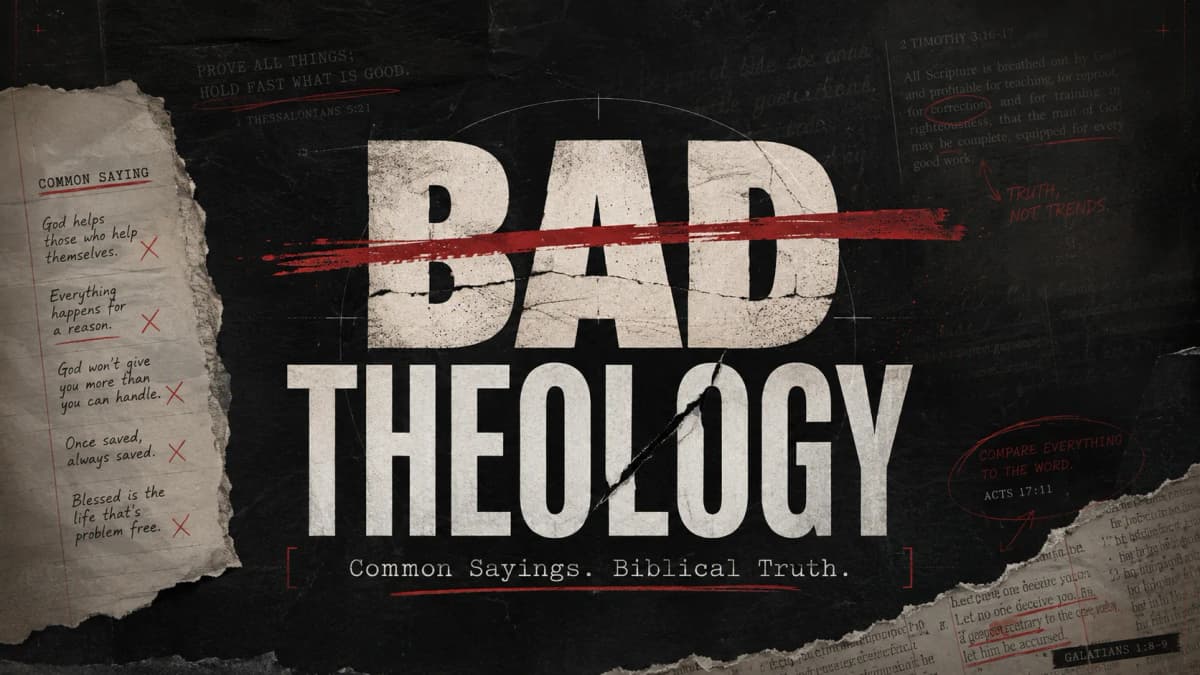
Most of these sentences have something true in them. We're not here to throw them out. We're here to catch the unbiblical ways they get used. This isn't black and white. We're not making a list of forbidden sentences. The same words can be true in one person's mouth and wounding in another's. It depends on who's saying it, when they're saying it, and what they mean by it.
You'll see that in the Bible. One man says something very close to this sentence about his own life, and it's one of the most beautiful lines in Scripture. Three other men say it to their friend in his grief, and God is angry with them for it. Same idea. Completely different use.
So the question we're asking isn't is this sentence right or wrong. It's when does it tell the truth about God, and when does it get used in a way the Bible doesn't support?
Where have you heard “everything happens for a reason”? What kind of moment was it? Why do you think people reach for this one? If you've heard it in your own pain, you may remember what it was like to hear it.
This sentence mostly gets said in hard rooms. Before we touch this, here's exactly what I am and am not going after. If by “everything happens for a reason” you mean God is in charge, nothing is outside his hand, and he's at work even in this, I'm not going after that. The church has confessed that for centuries, and some of you have held onto it through the worst weeks of your life. Keep holding.
The unbiblical use starts at one spot. It's when God is at work in this quietly becomes I know why this happened, or so it's good that it did.
That's the move we're testing. Just that one.
Source
Not the Bible. There's no single author. The idea is old. The Stoic philosophers taught that a rational order runs through everything, so whatever happens fits the whole and you should accept it.
Then in 1710 the philosopher Leibniz argued that God, being perfect, must have made the best of all possible worlds, so everything in it has a sufficient reason.
And then an earthquake hit Lisbon in 1755, on All Saints' Day, while the churches were full. Tens of thousands died. A few years later Voltaire wrote a novel called Candide, and he gave the world a character named Pangloss. Pangloss is a philosopher who walks through one catastrophe after another, shipwreck, war, disease, an earthquake, and keeps saying this is the best of all possible worlds and all is for the best.
Voltaire wrote him as a joke. A cruel one. Because he'd watched people say exactly that about Lisbon. So what was this sentence built to do? It was built to make suffering make sense. To keep the universe tidy. And it's been failing people in hard rooms for a very long time.
Instinct
What's true about this sentence? What would you not want to lose? Start with the belief it's trying to protect. It's reaching for providence. The belief that God governs the world, that nothing is loose, that your life is not a pile of accidents. The Heidelberg Catechism puts it beautifully: all things come to us not by chance but by his fatherly hand. That's the instinct, and it's right.
It's also reaching for meaning. Pain is easier to carry if it isn't pointless, and the person saying this is usually terrified that yours is. Why is it so hard to say nothing? Think of what it feels like to stand beside somebody you love and have no words that can fix it.
And honestly, most of the time, it's reaching for words. Somebody is standing in a funeral line with nothing to say, and this is the sentence that's lying around. They're not trying to hurt anyone. They love you and they're out of words.
So give them grace. Give yourself grace, because most of us have said it.
The Text
Where does the unbiblical use break? To answer that we go to the text, and we start with the verse everybody thinks this sentence comes from. Romans 8. But I want to start a little earlier than people usually do.
For we know that the whole creation has been groaning together in the pains of childbirth until now. And not only the creation, but we ourselves, who have the firstfruits of the Spirit, groan inwardly as we wait eagerly for adoption as sons, the redemption of our bodies. Likewise the Spirit helps us in our weakness. For we do not know what to pray for as we ought, but the Spirit himself intercedes for us with groanings too deep for words.
Count the groaning. Creation groans. We groan. And the Spirit of God groans. Paul does not get to verse 28 by stepping around suffering. He gets there by walking straight through it, and he says even the Holy Spirit doesn't have words for it.
Now here's the verse.
And we know that for those who love God all things work together for good, for those who are called according to his purpose. For those whom he foreknew he also predestined to be conformed to the image of his Son, in order that he might be the firstborn among many brothers.
Some of you have held onto this verse through the worst weeks of your life. It might be on a card on your refrigerator right now. So let me say this clearly: I'm not taking it from anybody.
I want to hand it back to you bigger than the greeting-card version, because this verse actually promises more than the sentence we're testing. It says all things work together for good. Not that all things are good. The diagnosis isn't good. The loss isn't good. You don't have to call it good. God is working in it. That's not less comfort. It's comfort you don't have to pretend about.
And it tells you what the good is. Verse 29: conformed to the image of his Son. The promise isn't that you'll get the outcome you prayed for. It's that nothing, not even this, can stop God from finishing what he started in you.
And listen to where Paul takes it. Ten verses later, he ends the chapter like this.
For I am sure that neither death nor life, nor angels nor rulers, nor things present nor things to come, nor powers, nor height nor depth, nor anything else in all creation, will be able to separate us from the love of God in Christ Jesus our Lord.
That's where verse 28 is headed. Not “this happened for a reason.” Nothing can separate you from him. Not even death. So keep the verse. Hold it tighter. Just notice it never tells you the reason. It tells you who's still holding you.
If anyone could say “everything happens for a reason,” it's Joseph. Sold by his brothers, falsely accused, forgotten in prison, and then raised up to save his whole family from famine. Listen to what he says to the brothers at the very end.
But Joseph said to them, “Do not fear, for am I in the place of God? As for you, you meant evil against me, but God meant it for good, to bring it about that many people should be kept alive, as they are today.”
That's providence, as clear as anywhere in Scripture. And look carefully at how he says it. He still calls it evil. You meant evil against me. He doesn't say what they did was secretly fine.
He refuses to play God. Am I in the place of God? And here's the one I want you to remember. He's saying this about his own story. Looking back. Joseph was seventeen in the pit. This is almost forty years later.
Nobody said Genesis 50:20 to Joseph in the pit. He said it himself, decades later, about his own life. What changes when the person who suffered says it, instead of the person watching? Joseph gives you a way to see that distinction.
That's the whole difference. You may someday be able to say something like this about your own suffering. That's yours to say, in your time. It is not ours to say to you in week one.
Now watch what Jesus does when people ask him the reason question directly. John 9.
As he passed by, he saw a man blind from birth. And his disciples asked him, “Rabbi, who sinned, this man or his parents, that he was born blind?” Jesus answered, “It was not that this man sinned, or his parents, but that the works of God might be displayed in him.”
The disciples ask the exact question our sentence asks. What's the reason? Somebody must have done something. And Jesus refuses the frame. Not this man. Not his parents. And then he turns the whole thing around. They're asking a backward question: why did this happen? He answers a forward one: what is God about to do here? And then he spits on the ground and heals the man.
He does it again in Luke 13. People come to him with the news of the day, a massacre and an accident, and they want to talk about what the victims must have done.
“Or those eighteen on whom the tower in Siloam fell and killed them: do you think that they were worse offenders than all the others who lived in Jerusalem? No, I tell you; but unless you repent, you will all likewise perish.”
Listen to what Jesus does here. People bring him the worst news of the week. A tower collapsed and eighteen people died. And the crowd wants to talk about what those people must have done to deserve it.
And Jesus defends the dead. No, I tell you. They weren't worse than anyone else. They weren't being punished. What happened to them was not a verdict on their lives.
And notice something small. He knows the number. Eighteen. Not “some people.” He counts them. No one who dies suddenly is a statistic to him. The hard words at the end, unless you repent, aren't aimed at the people who died, or at the ones who loved them. They're aimed at the bystanders. The people standing around explaining it.
So if you've lost someone suddenly, hear it from Jesus himself. It was not a punishment. And he does not stand at a distance from it. When his friend Lazarus died, Jesus went to the tomb knowing he was about to raise him. And John tells us, in the shortest verse in the Bible, that Jesus wept.
He weeps with you. He doesn't explain it to you first. Twice, Jesus is handed the reason question. Twice he refuses to give a reason. And twice he turns it toward what God will do.
Breaking Point
Job loses his children, his wealth, and his health in a matter of days. And three friends come to him. Watch what they do first.
Now when Job's three friends heard of all this evil that had come upon him, they came each from his own place, Eliphaz the Temanite, Bildad the Shuhite, and Zophar the Naamathite. They made an appointment together to come to show him sympathy and comfort him. And when they saw him from a distance, they did not recognize him. And they raised their voices and wept, and they tore their robes and sprinkled dust on their heads toward heaven. And they sat with him on the ground seven days and seven nights, and no one spoke a word to him, for they saw that his suffering was very great.
Seven days. On the ground. Not a word. Why were the friends at their best before they said anything? Look at what they gave Job in those seven days.
That was the best week those three men ever had. It was perfect ministry. And then they opened their mouths. And what they said, for thirty chapters, is “everything happens for a reason.” Here's Eliphaz, in his first speech.
Remember: who that was innocent ever perished? Or where were the upright cut off?
There has to be a reason, Job. Think harder. What did you do? And at the end of the book, God speaks to Eliphaz directly.
“My anger burns against you and against your two friends, for you have not spoken of me what is right, as my servant Job has.”
God is angry with the reason-givers. Not with the man who screamed at heaven for thirty chapters. With the men who explained. And here's the part that stops me every time. God speaks to Job out of the whirlwind for four chapters, and never once tells him why. Never mentions chapter 1. We know the reason. Job never finds out. And God calls Job the one who spoke rightly.
Why is explaining someone's suffering so tempting? What would it cost you to sit on the ground for a while instead? Those questions change what you reach for when you finally speak.
Better Word
What's truer, and what does it look like at the cross? What could you actually say at a funeral line or in a hospital hallway, to somebody whose world just ended? Here's mine.
“I don't know why this happened. But God hasn't left you, and neither have I.” The first half is honest, and it's the half Job's friends couldn't say. The second half is Job 2:13 put into words, and it's the only part the person will remember a year from now.
One more thing. There is one event in history where we actually know the reason. Peter says it on Pentecost: Jesus was delivered up according to the definite plan and foreknowledge of God, and you crucified him by the hands of lawless men.
Both halves. God's plan, and lawless men. The worst thing ever done, and the deepest purpose God ever had. Genesis 50:20 at the center of history. But notice. On Friday, nobody at the cross knew the reason. Saturday was silent. The reason only became visible from Sunday morning.
So if you're in a Friday right now, or a long Saturday, you are not wrong for not seeing it. Nobody at the cross could see it either. And God was not absent from the cross. He was on it.
Think of one person who might need you to sit on the ground with them this week. Not to explain anything. Just to show up.