
Read the session · 11 min
There are sentences we say about God. We say them at funerals. In hospital hallways. In a text message at eleven at night when somebody we love is coming apart. Some of those sentences are true. Some are half true. And some of them, if you say them to a person in the worst week of their life, do real damage.
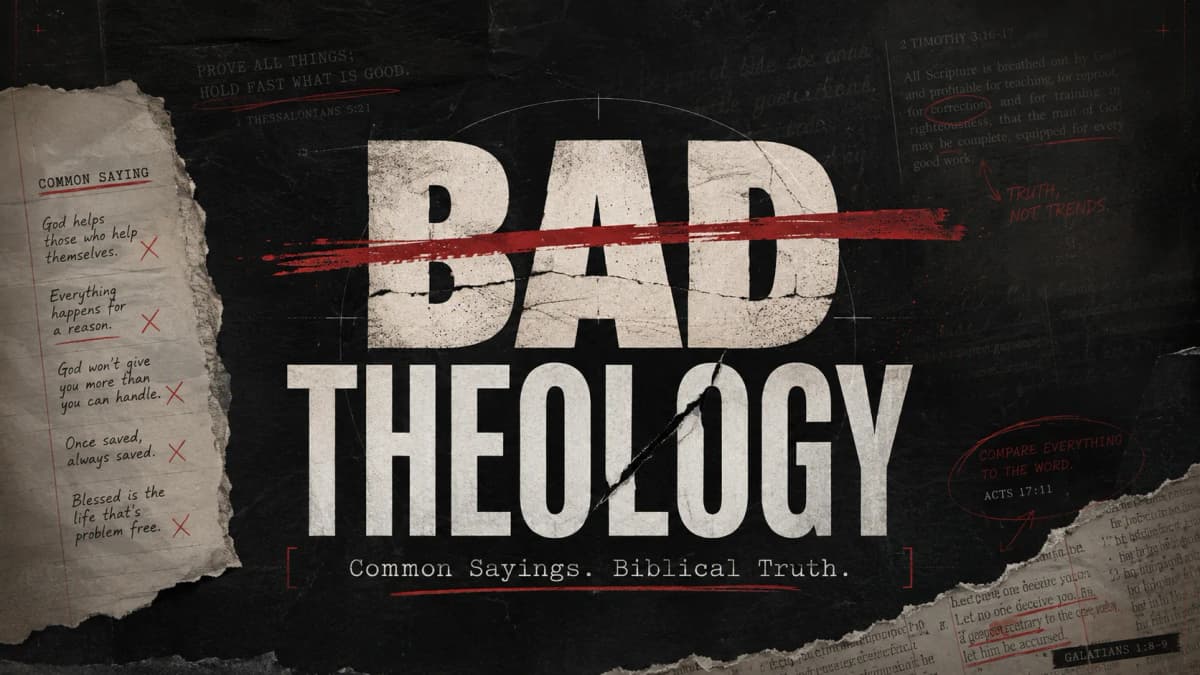
“God helps those who help themselves.” Have you heard this one? Have you said it? Where did you hear it? Who said it to you, and what was going on when they said it? Keep that person and that moment in mind as we look at the sentence.
Source
Do you think “God helps those who help themselves” is in the Bible somewhere? It isn't. Here's where it comes from instead. Benjamin Franklin printed it in Poor Richard's Almanack in 1736, and that's how America learned it. Franklin didn't make it up either. Algernon Sidney had it in print in the 1690s. And the idea underneath goes back further than that, to one of Aesop's fables. A wagon gets stuck in the mud. The driver sits down and prays to Hercules. Hercules shows up and tells him to put his shoulder to the wheel.
So look at what we're actually holding. A Greek fable, filtered through English political philosophy, popularized by a printer in Philadelphia who was, whatever else he was, not an evangelical.
What was this sentence built to do? It was built to get a man out of the mud. It's advice about initiative. About not sitting there when you could be pushing. And honestly, for a stuck wagon, it's fine advice. It was never advice about salvation. It was never making a claim about God at all.
We're the ones who brought it into church.
Instinct
What's right about this saying? Where have you actually seen the problem it's trying to solve? There's something here worth taking seriously before we take the sentence apart.
What is this sentence protecting? Because it is protecting something, and the something is real. It's protecting against passivity. Against the guy who quits his job because he's “waiting on the Lord.” Against the person who won't see a doctor because they're praying about it. Against using faith as a cover for doing nothing.
That is a real problem. Christianity is not passive. Paul talks about training like an athlete, working like a farmer, fighting like a soldier. So the instinct is right. The sentence is wrong. Both of those can be true at once.
The Text
For while we were still weak, at the right time Christ died for the ungodly. For one will scarcely die for a righteous person, though perhaps for a good person one would dare even to die. But God shows his love for us in that while we were still sinners, Christ died for us. Since, therefore, we have now been justified by his blood, much more shall we be saved by him from the wrath of God. For if while we were enemies we were reconciled to God by the death of his Son, much more, now that we are reconciled, shall we be saved by his life.
Now I want to show you something, and once you see it you won't be able to unsee it. Paul is describing us. The people Christ died for. And in about five verses he uses four different words for us. Watch him.
Verse 6. “While we were still weak.” The Greek word there is ἀσθενής, and it doesn't mean tired. It means without strength. Powerless. It's the word you'd use for a man lying by a pool who can't get himself into the water.
Same sentence, verse 6. Christ died for the ungodly. Verse 8. While we were still sinners. Verse 10. While we were enemies. Weak. Ungodly. Sinners. Enemies. Here's what I want you to notice. Watch the direction of that list.
If Paul were building an argument that God helps those who help themselves, this list would improve as it goes. It would start bad and get better. We were weak, but we were trying. We were sinners, but we were seeking. That's how you'd write it if the point were that we met God halfway.
It goes the other way. It gets worse. Weak is the mildest thing Paul says about us. Enemies is the last thing he says. He builds all the way to open hostility, and then he tells you that's when Christ died.
And not one of those four words describes somebody helping himself. Weak people can't. Ungodly people won't. Sinners are actively doing the opposite. And enemies are working against the very person who is about to die for them.
There's one more phrase in verse 6 that we read right past. “At the right time.” That's kairos, the appointed moment. Not when we were ready. Not when we'd made enough progress that God finally had something to work with. At the right time, and the right time was God's, and he picked it while we were still enemies.
Which of those four words is hardest for you to accept about yourself? Not in theory. About you. Keep that word in mind as you turn to Ephesians 2.
Paul does the same move here, but he pushes it further than he did in Romans.
And you were dead in the trespasses and sins in which you once walked, following the course of this world, following the prince of the power of the air, the spirit that is now at work in the sons of disobedience. Among whom we all once lived in the passions of our flesh, carrying out the desires of the body and the mind, and were by nature children of wrath, like the rest of mankind. But God, being rich in mercy, because of the great love with which he loved us, even when we were dead in our trespasses, made us alive together with Christ. By grace you have been saved. And raised us up with him and seated us with him in the heavenly places in Christ Jesus, so that in the coming ages he might show the immeasurable riches of his grace in kindness toward us in Christ Jesus. For by grace you have been saved through faith. And this is not your own doing; it is the gift of God, not a result of works, so that no one may boast.
Verse 1. “And you were dead in the trespasses and sins.” Dead. Not sick. Not struggling. Not underperforming. Not going through a rough stretch. Dead. Why does Paul say “dead” instead of “sick”? What changes if you swap those?
I want to stay on that word, because it's the word that ends this whole argument. You can help a sick man help himself. You can coach him. You can tell him to get up and try harder, and sometimes that actually works and it's the right thing to say. You cannot do that with a dead man. A dead man contributes nothing to his own resurrection. That's what dead means.
So if the picture Scripture gives us of our condition is a hospital, then “God helps those who help themselves” is decent advice. If the picture is a graveyard, it's nonsense.
Now look at verse 4. Two words, and they're two of the biggest words in the Bible. “But God.” Everything before those two words is us, dead, walking around doing what dead people do and calling it a life. Everything after them is God doing something we had no part in. There's no bridge between those two halves except him. Paul doesn't give us a step to take. He gives us a hinge, and God is standing on it.
And then Paul, who knows exactly what we're about to try to do with all of this, closes the door in verses 8 and 9. By grace you've been saved through faith. This is not your own doing. It's the gift of God. Not a result of works.
And then he tells us why he's closing the door. “So that no one may boast.” He knows us. He knows somebody is going to try to smuggle a contribution in there somewhere, and he names the reason we want to. We want a story where we did something.
One more. Luke 18. And I love this one because Jesus tells us up front exactly who he's aiming at.
He also told this parable to some who trusted in themselves that they were righteous, and treated others with contempt: “Two men went up into the temple to pray, one a Pharisee and the other a tax collector. The Pharisee, standing by himself, prayed thus: 'God, I thank you that I am not like other men, extortioners, unjust, adulterers, or even like this tax collector. I fast twice a week; I give tithes of all that I get.' But the tax collector, standing far off, would not even lift up his eyes to heaven, but beat his breast, saying, 'God, be merciful to me, a sinner!' I tell you, this man went down to his house justified, rather than the other. For everyone who exalts himself will be humbled, but the one who humbles himself will be exalted.”
Verse 9. He told this to people “who trusted in themselves that they were righteous.” That's our sentence. That's a man who helped himself. And here's the part that should make us all a little nervous. The Pharisee isn't lying. Every word of it is true. He did fast twice a week. He did give a tenth of everything he got. He wasn't an extortioner and he wasn't an adulterer. If you audited the man, the books would balance.
He is, by every measure you and I would actually use on a person, a good man who worked hard at being good. And he goes home unjustified.
Meanwhile the tax collector won't even lift his eyes. And what he prays is stronger in the Greek than most of our translations let on. “Be merciful to me” is close, but the word is the language of the mercy seat. Be propitiated toward me. Let the blood cover me. He isn't asking God to grade on a curve. He's asking for atonement.
And Jesus says it was that man who went home justified, and not the other one. So where does our sentence break? It doesn't break at the edges. It's not slightly off, needing a little adjustment. It breaks at the center, because it's pointed exactly backwards.
The gospel is not that God helps those who help themselves. The gospel is that God helps those who cannot help themselves. And our helplessness isn't the obstacle standing between us and grace. It's the precondition of it. It's the thing that qualifies us.
Which is how Paul can write a sentence like this one, in Romans 4.
And to the one who does not work but believes in him who justifies the ungodly, his faith is counted as righteousness.
God justifies the ungodly. Not the improving. Not the trying. Not the ones who got most of the way there on their own. The ungodly.
Breaking Point
Think back to the room where you heard this sentence. Picture saying it there, to that person. What happens? Who is this sentence cruelest to? What does it say to somebody who genuinely cannot help themselves? The person four days into a relapse. Somebody who just got a diagnosis. A woman whose marriage is ending and it wasn't her choice. Here's what I think this sentence does to a person like that.
It tells them that God's help is a reward for getting your act together. Which means the further down you are, the further away he is. And that is precisely backwards. It's the exact opposite of Romans 5. The further down you are, the more perfectly you match the description of the people Christ died for.
And notice something. The person most damaged by it is the person who most needs the gospel. It doesn't just get the theology wrong. It aims the wrong theology at exactly the people who can least afford it.
Better Word
What could you actually say to that person instead? Ordinary words, something you would say to your brother-in-law in his kitchen. Who would you say it to? Here's mine.
“God helps those who can't help themselves. That's the whole point.” I like it for two reasons. It's short enough that you'd actually say it out loud, and it doesn't require the person hearing it to know any theology at all.
And it isn't clever. It's just Romans 5:6 in plain English. While we were still weak, at the right time, Christ died for the ungodly. Think of one person who might need to hear that sentence sometime this week.