
Read the session · 15 min
Most of these sentences have something true in them. We're not here to throw them out. We're here to catch the unbiblical ways they get used. This isn't black and white, and it's not a list of forbidden words. The same sentence can be true in one mouth and crushing in another.
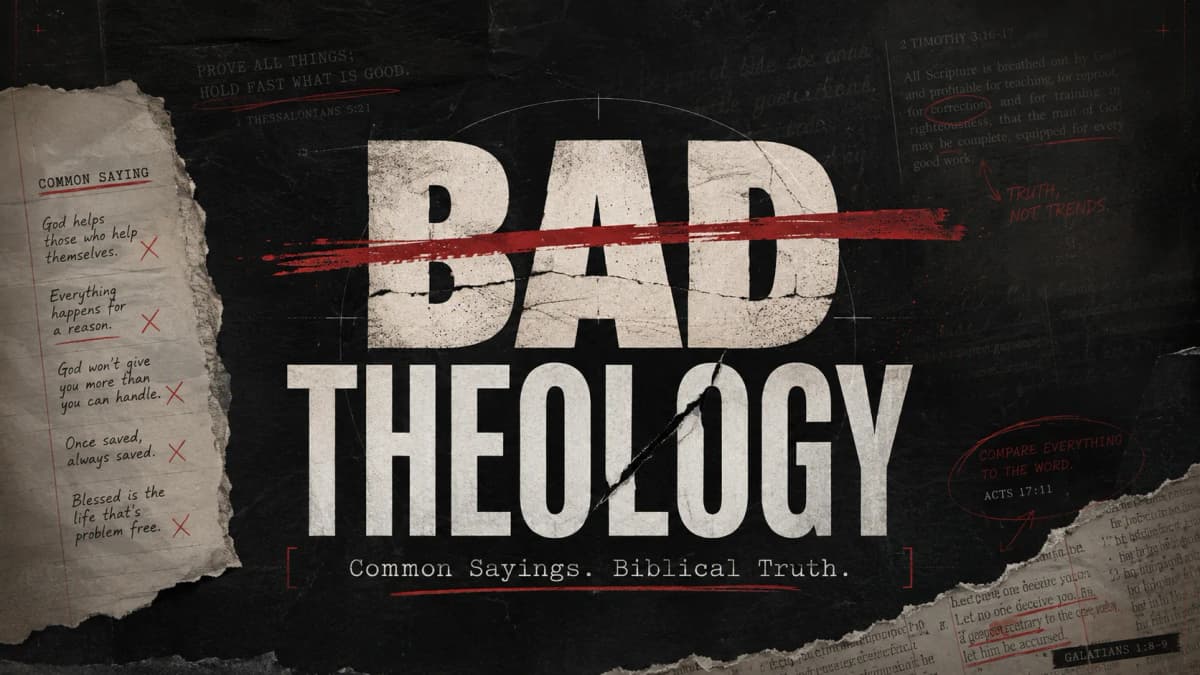
Where have you heard “God won't give you more than you can handle”? Have you said it to somebody else? Be honest, I have. Have you said it to yourself?
This one is mostly something you say to yourself. It's the one you repeat at two in the morning when you're doing the math on what's coming and it doesn't add up.
Before we touch it, here's exactly what I am and am not going after. If by this you mean God is faithful, that he knows exactly what you're made of, and that he is not going to walk off and leave you in the middle of it, I'm not going after that. That's true. That's actually the first half of the verse this sentence got built out of.
The unbiblical use starts at one spot. It's when the promise slides off of God's faithfulness and onto your capacity. When “God is with you in this” becomes “you've got this,” and then, three months later when you don't have it, becomes “something must be wrong with me.”
That slide is what we're testing. Just that.
Source
Not the Bible. This one is wearing a verse like a coat. Here's 1 Corinthians 10:13 in the King James, because that's the wording most of us absorbed without knowing it.
1 Corinthians 10:13 (KJV)
There hath no temptation taken you but such as is common to man: but God is faithful, who will not suffer you to be tempted above that ye are able; but will with the temptation also make a way to escape, that ye may be able to bear it.
Now take out one word. Take out “tempted.” What's left is “God will not suffer you above that ye are able.” That's our sentence. One word, and a promise about sin turns into a promise about suffering.
There's no author. Nobody made this up on purpose. It's what happens when a verse gets repeated so often that the context falls off. You will see it credited to Mother Teresa, usually in this form: “I know God will not give me anything I can't handle, I just wish he didn't trust me so much.” She didn't say it. The Mother Teresa Center, the organization that actually keeps her writings, publishes a list of quotes falsely attributed to her, and that one is on it.
Which is its own small lesson. Some of the sentences we're most sure about have no author, no verse, and no source. They just got passed around until they sounded like Scripture.
Instinct
What's true in this one that you wouldn't want to lose? When you've said it to yourself, what were you trying to do? There are real things underneath the sentence that deserve to be named.
It's protecting the faithfulness of God. Look at the middle of that verse again: God is faithful. That's the actual subject of the sentence. Not you. Him. And whoever says our phrase is usually reaching for exactly that, even if they've got the grammar backwards.
It's protecting the tenderness of God. Psalm 103 says he knows our frame, he remembers that we are dust. He's not up there overestimating us. He knows what we're made of better than we do.
And here's the third one, and it's the kindest reading. When somebody says this to you, they're paying you a compliment. What they mean is I believe in you. I've watched you. You're stronger than you think. That's love, spoken badly.
So before we take this apart, let's be clear that the people who said it to you were mostly trying to hold you up. There's one more thing it protects, and this one is less flattering, so I'll say it about myself. Sometimes it protects me. If I can tell you God won't give you more than you can handle, I've handed the problem back to you and I'm free to go. It's a sentence that lets me leave.
The Text
Now these things took place as examples for us, that we might not desire evil as they did. Do not be idolaters as some of them were; as it is written, “The people sat down to eat and drink and rose up to play.” Now these things happened to them as an example, but they were written down for our instruction, on whom the end of the ages has come. Therefore let anyone who thinks that he stands take heed lest he fall.
What's this paragraph about? Israel in the wilderness. The golden calf. Grumbling. Idolatry. Paul is warning the Corinthians about sin, and specifically about the overconfidence that walks into it. Let anyone who thinks that he stands take heed lest he fall.
And then, right on the heels of that warning, comes the comfort.
No temptation has overtaken you that is not common to man. God is faithful, and he will not let you be tempted beyond your ability, but with the temptation he will also provide the way of escape, that you may be able to endure it.
Four things in one verse, and not one of them is about how much hardship God hands out. One. Whatever's pulling at you is common to man. You are not a special case and you are not uniquely disgusting. Somebody else has stood exactly where you're standing.
Two. God is faithful. He's the subject. The reliability in this verse is his, not yours. Three. He will not let you be tempted beyond your ability. Notice what the limit is on. Temptation. Not cancer. Not a layoff. Not a marriage coming apart.
Four. There is always a way out, and the purpose of the way out is that you may be able to endure it. Escape and endurance in the same breath. The door isn't always out of the situation. Sometimes it's out of the sin.
So what does this verse actually promise? This: there will never be a moment in your life when sinning is your only option. Never. Not one. However cornered you feel, there is a door, and God himself guarantees it.
That's a bigger promise than the one on the mug. It's just a promise about a different thing. Here's the part that ought to settle it. The same man who wrote 1 Corinthians 10:13 wrote this about himself, a couple of years later, to the same church.
For we do not want you to be unaware, brothers, of the affliction we experienced in Asia. For we were so utterly burdened beyond our strength that we despaired of life itself. Indeed, we felt that we had received the sentence of death. But that was to make us rely not on ourselves but on God who raises the dead.
Burdened beyond our strength. Despaired of life itself. That's the Apostle Paul. Not a new believer, not someone with a weak faith. The man who wrote half the New Testament got more than he could handle, and he says so in writing, to a church, on purpose.
So if you've ever thought a stronger Christian could carry this, here's Paul telling you he couldn't. And then look at the next sentence, because Paul does something our phrase never does. He tells you why.
“But that was to make us rely not on ourselves but on God who raises the dead.” That's a purpose clause. The burden went past his strength on purpose. And the purpose wasn't to break him. It was to move his weight off of himself and onto God.
What changes if the load going past your strength is the point instead of the problem? Paul's answer asks you to look somewhere other than your own capacity.
Think about what our sentence does to that. If God only gives you what you can handle, then the whole point of your suffering is that you turn out to be adequate. Paul says the point is that you turn out not to be, and that this is where you find out who actually raises the dead.
And notice why he picked that name for God. Not God who is strong. Not God who helps. God who raises the dead. That's the God you need when you're past the end of yourself, because that God specializes in situations that are already over.
Keep reading, because Paul says one more thing and most people skip it.
He delivered us from such a deadly peril, and he will deliver us. On him we have set our hope that he will deliver us again. You also must help us by prayer, so that many will give thanks on our behalf for the blessing granted us through the prayers of many.
You also must help us. Paul asks for help. He doesn't handle it. He asks a church to pray him through it. There's a moment in the wilderness where Moses has had it. The people are complaining about food, again, and Moses says this to God.
I am not able to carry all this people alone; the burden is too heavy for me.
And he says something after that I'm not going to dress up. He tells God that if this is how it's going to be, God should just kill him now. That's in verse 15. Moses.
Now here's what I want you to see. God does not correct him. God doesn't say, Moses, I'd never give you more than you can handle. God agrees with him.
Then the LORD said to Moses, “Gather for me seventy men of the elders of Israel... And I will come down and talk with you there. And I will take some of the Spirit that is on you and put it on them, and they shall bear the burden of the people with you, so that you may not bear it yourself alone.”
So that you may not bear it yourself alone. God's answer to a load too heavy for one person was not more strength. It was seventy people. His father in law had already told him the same thing back in Exodus 18. You are not able to do it alone. Moses' problem was never a shortage of faith. It was that he was the only one carrying it.
One more, quickly. Paul had something he called a thorn, and he asked God three times to take it away.
Three times I pleaded with the Lord about this, that it should leave me. But he said to me, “My grace is sufficient for you, for my power is made perfect in weakness.”
God's answer to a burden he refused to remove was not “you're strong enough for this.” It was “my grace is enough, and my power works best in exactly the place where you've run out.”
Sufficient grace, not sufficient you.
Breaking Point
Here's where this sentence actually breaks, and it isn't in a commentary. It's in the head of the person who couldn't. Have you been on the receiving end of this sentence? What did it make you believe about yourself? That question takes us to the damage it can do.
Follow the logic with me. If God only gives you what you can handle, and you can't handle this, then there are only two conclusions available. Either God miscalculated, or you're the problem.
Nobody blames God. So people blame themselves. And that's the damage. This sentence takes somebody who is already at the bottom and hands them a second thing to carry, which is the belief that a real Christian would be doing better than this. And then it makes them quiet, because now they're ashamed. That's how this one isolates people. It doesn't just fail to help. It puts a lid on the room.
If God wanted us to believe that his people always cope, he picked a strange collection of books. There's a psalm in the middle of the hymnbook that does not end well.
O LORD, God of my salvation, I cry out day and night before you. Let my prayer come before you; incline your ear to my cry! For my soul is full of troubles, and my life draws near to Sheol.
And here's how it ends. This is the last verse of the psalm.
You have caused my beloved and my friend to shun me; my companions have become darkness.
That's it. That's the end. No turn, no “but I will yet praise him,” no sunrise in the last line the way most of the psalms have. It just stops in the dark.
And God put it in the songbook. He gave his people words for the week that doesn't resolve, and he did it on purpose, because he knew some of us would need them.
So if that's where you are, you are not outside of Scripture. You're in it. There's a page with your name on it. What did somebody actually do for you that helped, when you were past your limit? Keep that help in mind as you look at what God does for Elijah.
Look at Elijah, right after the biggest victory of his life. He runs into the wilderness, sits down under a tree, and asks God to take his life. It is enough.
And God doesn't rebuke him, and doesn't argue with him. God lets him sleep. Then an angel touches him and feeds him. Then lets him sleep again, and feeds him again. And the angel says this: Arise and eat, for the journey is too great for you.
God says it out loud. The journey is too much for you. And then he gives him food, rest, a quiet voice instead of a whirlwind, and eventually a coworker named Elisha.
Sleep, a meal, a whisper, and a friend. That's God's treatment plan for a prophet who wanted to die. Not one word about handling it. What keeps you from asking for the seventy elders? From letting somebody help carry what you can't? Moses asked. Paul asked. Their stories give you room to ask too.
Better Word
What's truer, and what does it look like at the cross? What could you say to somebody at the end of their rope, or to yourself at two in the morning? Here's the sentence I'd offer.
It isn't original to me. I got it from a few writers who've said it better than I can. “He will give you more than you can handle. He won't give you more than he can.”
Now take the sentence to the cross. In the garden, the night before he died, Jesus said this to his friends.
Then he said to them, “My soul is very sorrowful, even to death; remain here, and watch with me.” And going a little farther he fell on his face and prayed, saying, “My Father, if it be possible, let this cup pass from me; nevertheless, not as I will, but as you will.”
Three things in that scene, and all three contradict our sentence. He said it was too much. Sorrowful, even to death. That's the Son of God, and he does not pretend to be fine.
He asked for company. Remain here, and watch with me. He wanted people in the room. He asked out loud. And they fell asleep, and he asked again.
And the cup was not taken away. He prayed for the load to be lightened, and the answer was no, and he went to the cross and carried all of it. On the cross he said My God, my God, why have you forsaken me?
So don't ever let anybody tell you God sizes the burden to the shoulder. He gave his own Son more than any human being could handle. And that's why the sentence flips. Christ took what nobody could carry, so that what you can't carry has somewhere to go. Here's how he says it himself.
Come to me, all who labor and are heavy laden, and I will give you rest. Take my yoke upon you, and learn from me, for I am gentle and lowly in heart, and you will find rest for your souls. For my yoke is easy, and my burden is light.
Notice he doesn't say you can handle it. He says bring it here. A yoke is built for two animals, and he's already in it. Peter puts it one more way: humble yourselves under the mighty hand of God, casting all your anxieties on him, because he cares for you. That word “casting” hangs on “humble yourselves.” Handing it over is the humble move. Keeping it is the proud one.
Think of one thing you're carrying by yourself right now that somebody in your life could be carrying with you. And think of the one person you'd have to tell. Tell them this week. Bear one another's burdens, Paul says, and that's how you fulfill the law of Christ.